Collected This page has been added to your collection.
Subscribe to our RSS feeds

Clicking on subscribe will add an RSS feed into your default RSS reader.

Pages you have collected
4
Downloading your document Please provide us with your details before downloading your PDF.
*

* We promise not to pass your details on to anyone for any reason. For more details, please reaad our privacy policy.

Thank you.

Your document should download automatically.
If it doesn’t appear in your download queue, please click here.

Close
Roundhouse
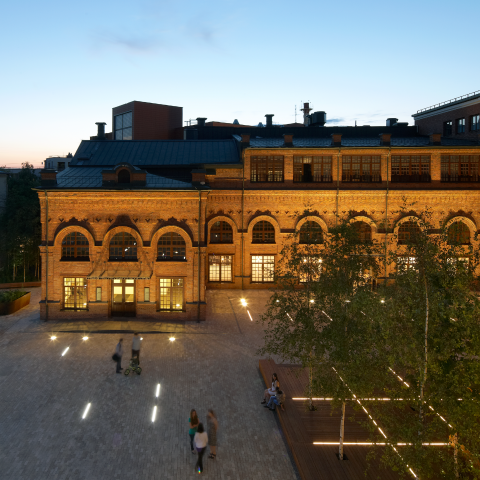
The transformation of the redundant Grade II* listed Roundhouse as a leading London arts venue required a fusion of architectural skill, historical respect, and the visionary determination of private and public funders over a long period - a complex and cost-sensitive design scenario. A wide range of architectural interventions, careful reinstatements, and newbuild have given the Roundhouse a new identity, made it a major player on the national arts scene – and triggered new local commercial and residential property development.
Read more >
The practice led a multi-disciplinary team to repair existing main fabric, re-programme sections of the building, modernise the auditorium, and create a three-level administrative and circulation ’girdle’. Key features include a top-lit galleria, connected to the auditorium by post-industrially detailed glass and metal bridges. The new wing allows a large section of the Roundhouse’s original facade, originally below ground on the sloping site, to be exposed for the first time. This accentuates the co-existence of historic and contemporary architecture to great effect and, with better connections to the streetscape, has heightened the Roundhouse’\'s contribution to the urban scene.

Structural interventions were minimised to emphasise the Victorian building’s structure and aesthetic. New circulation and administrative segments are thoroughly contemporary, but detailed in sympathy with the building’s original industrial soul. McAslan also increased audience and specialist-use capacity, and the building’s functional range, without disrupting key aspects of its form.

A particularly significant intervention concerned the railway turntable ash-pits in the Roundhouse’s extraordinary radial undercroft. These were cleared of tons of detritus, subjected to meticulous remedial work, and the installation of new services, access and circulation routes (without unduly disrupting the geometry of the building’s brick-built substructure). The result is the new Roundhouse Studios, for use by creative local youngsters.

There was extensive remedial work on the rafters and boarding, with a ’sprung’ acoustic mass added to the roof. This demanded a new steel upper structure, which supports a 20-tonne load from the new technical grid. The solution, by Paul Gillieron Acoustic Design, has created virtually no disruptive visual impact.
 
Of the total £30m spend, design and construction costs for the Roundhouse scheme were below £20m – a fraction of the cost of an equivalent new arts venue of this versatility. One critic described the new Roundhouse as ’one of the most radical experiments we have yet seen in cultural interaction, a venture that aims to set a model for a multicultural society.’
  • Type

    Buildings

  • Sector

    -

  • Location

    Camden, London

  • Description

    -

  • Client

    Norman Trust

  • Size

    6,600 sqm

  • Cost

    £30 million

  • Team

    John McAslan + Partners, Architect
    SKM Anthony Hunt Associates, Structural Engineer Buro Happold, MEP Engineer
    Gardiner & Theobald, Cost Consultant
    Paul Gillieron, Acoustic Engineer
    Theatre Projects, Theatre Consultant
    Anne Minors Performance, Performance and Seating Consultant
    Modus Operandi, Art Consultant
    Tolent Construction, Main Contractor
    David Bonnett Associates, Access Consultant

  • Status

    Completed 2006